
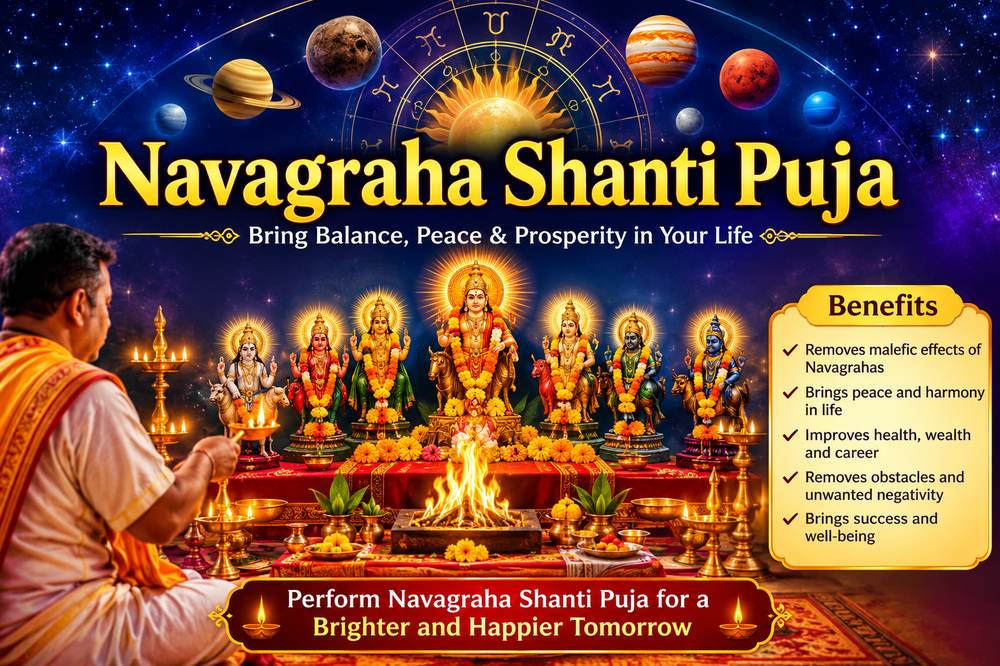
In Vedic astrology, the nine planetary influences known as the Navagrahas are traditionally considered important in understanding different aspects of human life. These include the Sun, Moon, Mars, Mercury, Jupiter, Venus, Saturn, Rahu and Ketu.
When a person experiences repeated challenges that are interpreted through their horoscope, some families choose to perform Navagraha Shanti Puja as a traditional spiritual and astrological remedy.
The purpose of this Puja is to worship the Navagrahas, seek divine blessings and perform prescribed prayers and rituals according to the individual’s circumstances.
But when should Navagraha Shanti Puja be performed? Is it necessary for everyone? What are the traditional Navagraha Puja benefits?
This complete guide explains the meaning, importance, procedure, benefits and commonly considered occasions for performing Navagraha Shanti Puja.
What Is Navagraha Shanti Puja?
Navagraha Shanti Puja is a traditional Hindu ritual performed to worship and seek blessings associated with the nine Grahas recognised in Vedic astrology.
The nine Navagrahas are:
- Surya – Sun
- Chandra – Moon
- Mangala – Mars
- Budha – Mercury
- Guru – Jupiter
- Shukra – Venus
- Shani – Saturn
- Rahu
- Ketu
In traditional astrology, these Grahas are associated with different areas of life, personality tendencies and experiences.
Navagraha Shanti Puja may be performed when an astrologer identifies challenging planetary influences in a person’s Kundli or when a family wishes to undertake a general spiritual observance dedicated to the Navagrahas.
What Is the Purpose of Navagraha Shanti Puja?
The word “Shanti” refers broadly to peace or pacification.
The traditional purpose of Navagraha Shanti Puja is to seek peace and balance in relation to planetary influences through prayer, mantra, offerings and devotional rituals.
Depending on the individual’s horoscope, the ceremony may focus more strongly on a particular Graha.
For example, if Saturn is considered particularly challenging in a person’s horoscope, the ritual may include specific prayers associated with Shani Dev.
Similarly, other planetary influences can receive additional attention based on the astrologer’s assessment.
Why Are the Navagrahas Important in Vedic Astrology?
Vedic astrology associates different Grahas with different areas of life.
Surya – Sun
The Sun is traditionally associated with confidence, authority, vitality, leadership and one’s sense of identity.
Chandra – Moon
The Moon is associated with emotions, mind, mental tendencies, comfort and sensitivity.
Mangala – Mars
Mars represents courage, energy, determination, action and assertiveness.
Budha – Mercury
Mercury is traditionally associated with communication, intellect, learning, reasoning and business skills.
Guru – Jupiter
Jupiter is associated with wisdom, knowledge, guidance, expansion and spiritual learning.
Shukra – Venus
Venus is traditionally associated with relationships, beauty, comfort, art, luxury and material enjoyment.
Shani – Saturn
Saturn is associated with discipline, responsibility, patience, hard work and long-term lessons.
Rahu
Rahu is traditionally associated with ambition, material desires, unconventional experiences and sudden changes.
Ketu
Ketu is associated with detachment, spirituality, introspection and liberation-oriented tendencies.
These are traditional astrological associations and should not be interpreted as scientific causes of life events.
Navagraha Puja Benefits
People perform Navagraha Shanti Puja for various spiritual and traditional reasons.
The commonly discussed Navagraha Puja benefits include the following.
- Traditional Planetary Shanti
The primary purpose is to seek peace and balance in relation to challenging planetary influences identified in the horoscope.
The ritual includes prayers and mantras dedicated to the Navagrahas.
- Spiritual Peace
Participating in a structured Puja can provide an opportunity for prayer, reflection and spiritual focus.
Many people find religious rituals helpful in creating a peaceful atmosphere.
- Seeking Divine Blessings
Navagraha Shanti Puja allows devotees to pray for blessings, guidance and strength while facing important periods of life.
- Support During Challenging Astrological Periods
People may consider Navagraha Puja during difficult Dasha or Antardasha periods identified through their horoscope.
The ritual is traditionally performed as a remedial practice rather than as a guarantee that difficulties will disappear.
- Positive Spiritual Intention
The Puja encourages individuals to focus on constructive intentions, prayer and disciplined spiritual practice.
- Family Participation
A Navagraha Puja can be performed with family members, allowing everyone to participate in prayer and traditional rituals together.
- Traditional Remedy for Planetary Doshas
When a horoscope is interpreted as having certain planetary challenges, Navagraha Shanti Puja may be recommended as one of several traditional remedies.
When Should You Perform Navagraha Shanti Puja?
There is no single situation in which everyone must perform Navagraha Shanti Puja.
An astrologer may recommend it in circumstances such as:
- Challenging planetary periods
- Significant Dasha or Antardasha
- Shani-related concerns
- Rahu-Ketu-related concerns
- Certain Doshas identified in the Kundli
- Before important life transitions
- After beginning a major new venture
- During certain religious observances
- When a family wishes to perform a general Navagraha prayer
The recommendation should ideally be based on the person’s horoscope and the purpose of the Puja.
Navagraha Shanti Puja for Difficult Dasha Periods
In Vedic astrology, Dasha refers to planetary periods used to analyse the timing of events and experiences.
When a particular planet’s Dasha or Antardasha is considered challenging, some astrologers recommend appropriate remedial practices.
For example, a person going through a difficult Saturn period may be advised to perform Shani-related worship as part of a broader remedial approach.
However, the Dasha should always be analysed alongside the planet’s strength, house placement, aspects and other horoscope factors.
Navagraha Shanti Puja for Shani-Related Concerns
Saturn is one of the Grahas for which people frequently seek spiritual remedies.
Individuals may consider Shani-related worship during difficult periods or when Saturn is interpreted as challenging in their Kundli.
Navagraha Shanti Puja can include prayers for Shani along with worship of the other Grahas.
Depending on the horoscope, a priest or astrologer may recommend a more specific Shani Puja instead.
Navagraha Shanti Puja for Rahu and Ketu
Rahu and Ketu are particularly important in Vedic astrology because of their connection with the lunar nodes.
They are traditionally associated with unexpected experiences, detachment, ambition, transformation and spiritual themes.
When Rahu or Ketu is considered challenging in a Kundli, an astrologer may recommend Navagraha worship or a more specific Rahu-Ketu remedy.
Navagraha Shanti Puja and Marriage
Some people ask whether Navagraha Shanti Puja can be performed before marriage.
It may be included in a broader marriage-related spiritual programme when an astrologer identifies planetary concerns.
However, Navagraha Puja should not replace Kundli matching or a complete marriage compatibility analysis.
Factors such as the 7th house, Venus, Jupiter, Moon, relevant Dashas and overall compatibility should be considered separately.
Navagraha Shanti Puja for Career
Career concerns are another reason people seek astrological remedies.
Vedic astrology traditionally examines the 10th house, 10th lord, Sun, Saturn, Jupiter and other factors when assessing professional life.
If a person is going through a challenging planetary period, Navagraha Shanti Puja may be recommended as a spiritual remedy.
It should not, however, be considered a guaranteed method of securing a job, promotion or business success.
Navagraha Shanti Puja for a New Business
Some families and business owners perform Navagraha Puja before starting a new business, office or major venture.
The ceremony can serve as a traditional prayer for an auspicious beginning.
For a business launch, the Puja may be combined with Ganesh Puja, Lakshmi Puja or other rituals according to the family’s tradition.
How Is Navagraha Shanti Puja Performed?
The exact procedure varies according to the tradition, purpose and priest conducting the ceremony.
A typical ceremony may include the following steps.
Step 1: Preparation
The Puja area is cleaned and the required Samagri is arranged.
A suitable Muhurat may be selected depending on the purpose of the ritual.
Step 2: Sankalp
The priest performs the Sankalp, stating the purpose of the Puja and identifying the person or family for whom the ritual is being conducted.
Step 3: Ganesh Puja
Lord Ganesha is traditionally worshipped before beginning many Hindu rituals.
Step 4: Kalash Sthapana
A sacred Kalash may be established as part of the ceremony.
Step 5: Navagraha Avahan
The priest invokes the nine Grahas using prescribed mantras and ritual procedures.
Step 6: Graha-Specific Worship
Each Navagraha is worshipped using appropriate mantras, flowers, offerings and other ritual materials.
If a particular planet is the main focus, additional prayers may be performed.
Step 7: Mantra Recitation
The priest recites the relevant Navagraha mantras.
The number and type of recitations can vary depending on the ritual.
Step 8: Havan
Many Navagraha Shanti ceremonies include a sacred fire ritual.
Prescribed offerings are made into the Havan fire while the relevant mantras are recited.
Step 9: Purnahuti
The main Havan is concluded with Purnahuti, the final offering.
Step 10: Aarti and Prasad
The ceremony concludes with Aarti and distribution of Prasad.
The family may then receive blessings from the priest.
Navagraha Shanti Puja Samagri
The required Navagraha Puja Samagri depends on the exact ritual.
Common items may include:
- Navagraha idols or symbolic representations
- Kalash
- Water
- Rice or Akshat
- Flowers
- Fruits
- Betel leaves
- Betel nuts
- Kumkum
- Turmeric
- Sandalwood
- Incense
- Ghee
- Havan Samagri
- Sacred wood
- Cotton wicks
- Diya
- Different offerings associated with individual Grahas
- Cloth
- Grains
- Coins
The priest should provide the final list because a detailed Navagraha Shanti Puja may require additional items.
How Long Does Navagraha Shanti Puja Take?
The duration depends on the type and scale of the ceremony.
A simple Navagraha Puja may be completed relatively quickly, while an elaborate Shanti Puja involving extensive mantra recitation, Havan and additional rituals can take considerably longer.
Before booking the ceremony, ask the priest about the expected duration and required preparations.
Which Day Is Best for Navagraha Shanti Puja?
There is no single universally applicable day for every Navagraha Puja.
The preferred day and Muhurat may depend on:
- Purpose of the Puja
- Individual horoscope
- Planet being addressed
- Panchang
- Tithi
- Nakshatra
- Local timing
- Family tradition
For a personalised remedy, an astrologer may select the Muhurat according to the person’s Kundli.
Can Navagraha Shanti Puja Be Performed at Home?
Yes, Navagraha-related worship can be performed at home when the space and ritual requirements are suitable.
A simple prayer may be performed by the family, while an elaborate Navagraha Shanti Puja involving specific Vedic mantras and Havan is generally better conducted by an experienced priest.
The priest can guide the family through Sankalp, mantra recitation, offerings and the concluding rituals.
Is Navagraha Shanti Puja Necessary for Everyone?
No.
Not everyone requires Navagraha Shanti Puja.
A person’s horoscope may contain both challenging and supportive planetary influences. A particular planetary placement does not automatically mean that a ritual is required.
A personalised horoscope analysis can help determine whether a specific planetary remedy is appropriate.
Navagraha Shanti Puja vs Individual Planetary Puja
These two approaches are related but not identical.
Navagraha Shanti Puja addresses the nine Grahas collectively.
An individual planetary Puja focuses primarily on one Graha—for example, Shani Puja for Saturn or Rahu Puja for Rahu.
The appropriate option depends on the horoscope and the specific concern being addressed.
How to Choose a Priest for Navagraha Shanti Puja
If you are planning a Navagraha Shanti Puja, choose a priest who can clearly explain:
- Which ritual will be performed
- Why the Puja is being recommended
- Which mantras will be used
- What Samagri is required
- How long the ceremony will take
- Whether Havan is included
- Whether a specific Muhurat is required
Avoid choosing a ritual solely because someone claims that it will guarantee wealth, marriage, health or success.
Final Thoughts on Navagraha Shanti Puja
Navagraha Shanti Puja is a traditional Hindu ritual performed to worship the nine Grahas and seek peace, blessings and spiritual support.
The commonly discussed Navagraha Puja benefits include spiritual peace, devotional focus, family participation and traditional support during challenging planetary periods.
The ritual may be considered during difficult Dashas, certain astrological Doshas, major life transitions or important new beginnings.
However, Navagraha Puja is not required for everyone, and it should not be treated as a guaranteed solution to personal problems.
A meaningful approach begins with understanding the horoscope, identifying the relevant planetary influences and then selecting an appropriate traditional remedy.
If you believe your Kundli shows challenging planetary influences and want to understand whether Navagraha Shanti Puja is appropriate, a personalised consultation with an experienced astrologer or Vedic priest can help you choose the right ritual and procedure.
Frequently Asked Questions About Navagraha Shanti Puja
What is Navagraha Shanti Puja?
Navagraha Shanti Puja is a traditional Hindu ritual dedicated to the nine Grahas of Vedic astrology. It is performed to seek blessings and peace in relation to planetary influences.
What are the benefits of Navagraha Puja?
Traditional Navagraha Puja benefits include spiritual peace, focused prayer, seeking planetary blessings and performing a traditional remedy during challenging astrological periods.
When should Navagraha Shanti Puja be performed?
It may be performed during challenging planetary Dashas, certain Doshas, important life transitions or when recommended after a horoscope analysis.
Can Navagraha Puja be performed at home?
Yes. A simple form can be performed at home. For an elaborate Vedic Navagraha Shanti Puja, an experienced priest is generally recommended.
How many planets are worshipped in Navagraha Puja?
Nine Grahas are traditionally worshipped: Sun, Moon, Mars, Mercury, Jupiter, Venus, Saturn, Rahu and Ketu.
Is Navagraha Shanti Puja necessary for everyone?
No. The need for a planetary remedy depends on the individual’s horoscope and circumstances.
Does Navagraha Puja remove all problems?
No religious ritual should be presented as a guaranteed solution to every problem. Navagraha Puja is traditionally performed as a spiritual and astrological remedial practice.
Can Navagraha Puja be performed before marriage?
Yes, it can be included as part of a traditional pre-marriage spiritual ceremony when appropriate. However, it does not replace detailed Kundli matching and marriage compatibility analysis.